
Financing for Developoment (FfD)
Financing for Development is neither a pledging nor fundraising process to finance SDG implementation. It is meant to create the policy and fiscal space for developing countries to finance their development in a sustainable way.
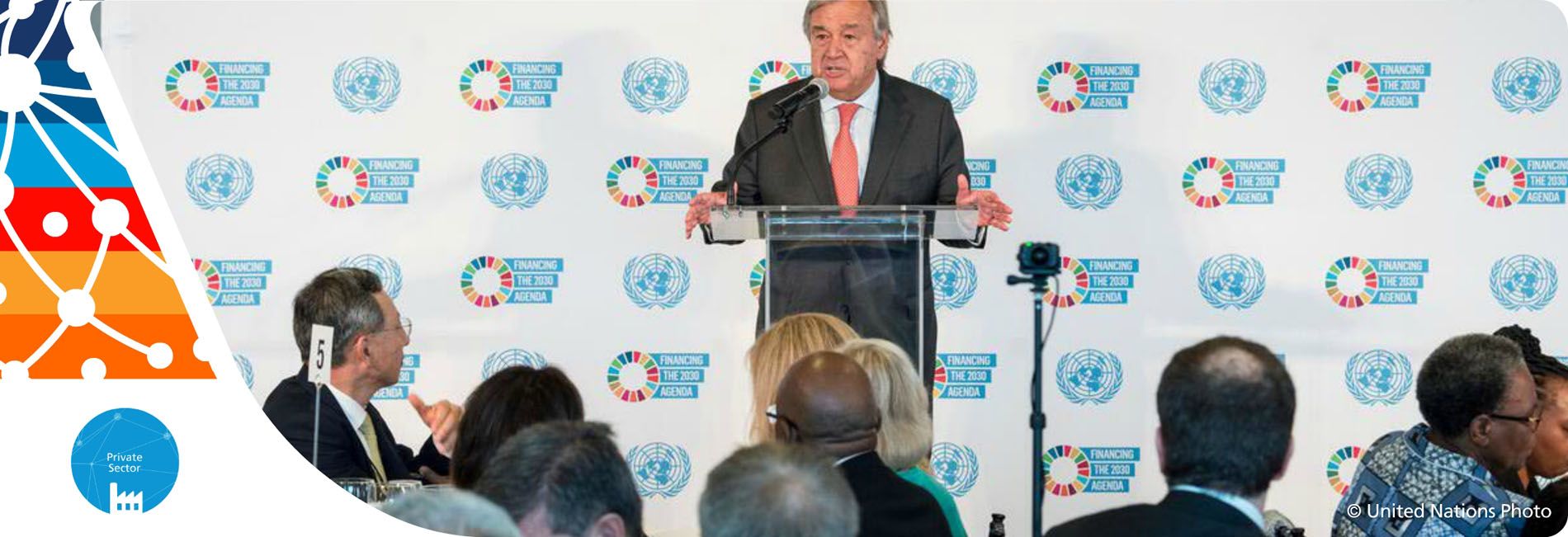
The FfD process is centered around supporting the follow-up to the agreements and commitments reached during the three major international conferences on Financing for Development: in Monterrey, Mexico in 2002; in Doha, Qatar in 2008; and in Addis Ababa, Ethiopia in 2015.
The Addis Agenda provided a new global framework for financing sustainable development, which supports implementation of the 2030 Agenda, including the Sustainable Development Goals (SDGs). It aligns all domestic and international resource flows, policies and international agreements with economic, social and environmental priorities and serves as a guide for further actions by governments, international organizations, the business sector, civil society, etc.
The specific action areas of the Addis Agenda are:
- Domestic public resources;
- Domestic and international private business and finance;
- International development cooperation;
- International trade as an engine for development;
- Debt and debt sustainability;
- Addressing systemic issues;
- Science, technology, innovation and capacity building;
- Data, monitoring and follow-up.
The Addis Agenda established an annual ECOSOC Forum on Financing for Development (FfD Forum), an intergovernmental process with universal participation mandated to review the progress on the financing for development outcomes and the means of implementation of the 2030 Agenda. The center piece of this discussion is the annual Financing for Sustainable Development Report.
An integral part of this annual review is a 2-day retreat that convenes Governments, international organizations, multilateral development banks, renowned experts, private sector, civil society and other relevant stakeholders to discuss, in an open and informal space, the most pressing issues on the FfD process. The retreat is organized by the «Friends of Monterrey» Group, consisting of Mexico, Germany and Switzerland.
Though the FfD process is a UN activity, it includes International Financial Institutions (IFIs), the civil society and the private sector as recognized stakeholders. This is the reason why the FfD conferences are ‹international› and not ‹UN› conferences, making the FfD process a uniquely inclusive space for discussing the global economic system in all its systemic dimensions.
As we stand at the halfway point of the decade of action for the SDGs and the 2030 Agenda the global economic outlook remains fragile amid a highly challenging environment. Countries are facing difficult economic policy trade-offs and recent shocks are threatening to further reverse progress on the 2030 Agenda. Both immediate and longer-term measures are urgently needed to effectively finance responses to multiple overlapping crises while scaling up essential investments in the SDGs.
Against this background the UN General Assembly decided in December 2023 to hold a fourth Financing for Development Conference in 2025.
Melina Papageorgiou follows the FfD Reform within the UN and MDBs Section of SDC.